Bedbugs, the return of a scourge
Long considered eradicated in developed countries, bedbugs (Cimex lectularius) have been increasingly causing problems since the 1990s in both private and public environments. This phenomenon, confirmed by ANSES, the French food and health agency, can be explained by a number of factors, including the rise of more nomadic lifestyles, the widespread use of second-hand goods and the emergence of growing resistance to conventional insecticides.
The presence of bedbugs can have major repercussions for public health. In addition to the physical problems (pruritus, night-time bites, etc.), infestations can lead to sleep disturbances and a deterioration in overall well-being.
Faced with these challenges, heat treatments, including the use of steam, are now recommended as a first-line treatment by the health authorities (ANSES 2023).
Some clarification is however needed. In the literature, there are often references to temperature without precise measurements. The most recent scientific data indicates that a temperature of around 50°C is lethal for bedbugs at all stages of development.
In this context, professional solutions such as Sanivap steam generators, which deliver a constant temperature of 97°C at the accessory outlet, offer a scientifically proven and operationally reliable method for bedbug eradication, even in the most complex areas.
Understanding the biology and lethal thermal thresholds of bedbugs
Bedbugs are nocturnal, photophobic haematophagous insects whose way of life is closely linked to the presence of humans. They gather in discreet groupings during the day, in dark, narrow hiding places in the immediate vicinity of their host’s bed (mattress seams, cracks, skirting boards, electrical sockets, etc.).
Feeding, also known as a “blood meal,” lasts about ten minutes, but insects can survive from two to five months without feeding, with a total life expectancy of about a year. Reproduction is rapid; a fertilised female lays an average of five eggs a day. The eggs hatch in 7-15 days, and the larvae go through five development stages, requiring a blood meal at each moult before reaching the adult stage.
THERMAL SENSITIVITY THRESHOLDS : CONCLUSIONS FROM SCIENTIFIC RESEARCH AND ANSES
Numerous studies have been carried out to determine lethal temperatures for bedbugs, depending on their stage of development:
• Benoit et al. (2009) : exposure to 48°C for one hour kills almost all bedbugs.
• Pereira et al. (2009) : 100% mortality after 120 minutes at 41°C, 25 minutes at 42°C, or 1 minute at 49°C.
• How & Lee (2010) : lethal temperature varies according to stage, ranging from 39°C for eggs to 46°C for adults.
• Kells and Goblirsch (2011), Loudon (2017): rapid mortality from 45°C, with complete lethality in less than one minute at 50°C.
These results are confirmed by the ANSES report (2023), which concludes as follows:
“Exposure for several hours to temperatures around 40°C or for a few minutes to temperatures above 46°C results in insect death.”
These data provide a sound scientific basis for evaluating heat treatments to combat bedbugs.
Review of the scientific literature on the effectiveness of steam against bedbugs
High-temperature steam is now recognised as a leading solution in the fight against bedbugs, provided that certain technical conditions are met, including the temperature reached at the point of contact and the duration of exposure. The ANSES collective expertise report, published in May 2023, consolidates the main scientific studies on the subject.
The study by Puckett, McDonald and Gold (2013) evaluated a steam device in an experimental setting simulating a bed, with application times of between 10 and 30 seconds. Results showed:
• 100% egg mortality.
• 88 to 94% mortality of larvae and adults.
• Conclusion: high efficacy on eggs and slightly less on more advanced stages.
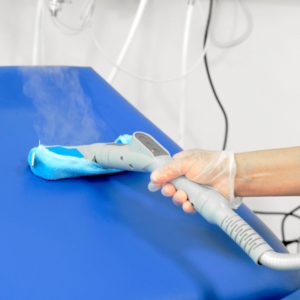
Wang et al. (2018) compared three models of steam generators (consumer and professional), with outlet temperatures measured between 71.9°C and 82.7°C and exposure times of 1 to 8 seconds. They observed:
• 100% mortality for all stages on mattresses and in cracks.
• 89% under fabrics.
• No efficacy under leather, highlighting the impact of the treated surface.
This study is considered of good quality by ANSES, due to the diversity of situations tested, the rigour of the measurements and the statistical analysis of the results.
ANSES SUMMARY ON STEAM : AN EFFECTIVE BUT DEMANDING METHOD
In its 2023 report, ANSES confirmed the effectiveness of steam treatment in the fight against bedbugs. Classified as a highly effective method, this approach has a low level of uncertainty, provided the technical conditions are met.
However, the agency stresses that this method remains moderately applicable, particularly due to the difficulty of reaching all bedbug locations, especially narrow or protected areas that are often inaccessible.
In terms of public risk, steam treatment poses no risk to human health. Its environmental impact is considered moderate, mainly because of the potential to alter certain sensitive materials if used inappropriately.
In conclusion, the higher the temperature at the point of contact, the shorter and more effective the exposure. This is why steam is now a cornerstone of integrated pest control strategies, particularly in sensitive collective environments, where safety, hygiene and effectiveness must work simultaneously together.
Sanivap : a benchmark solution against bedbugs
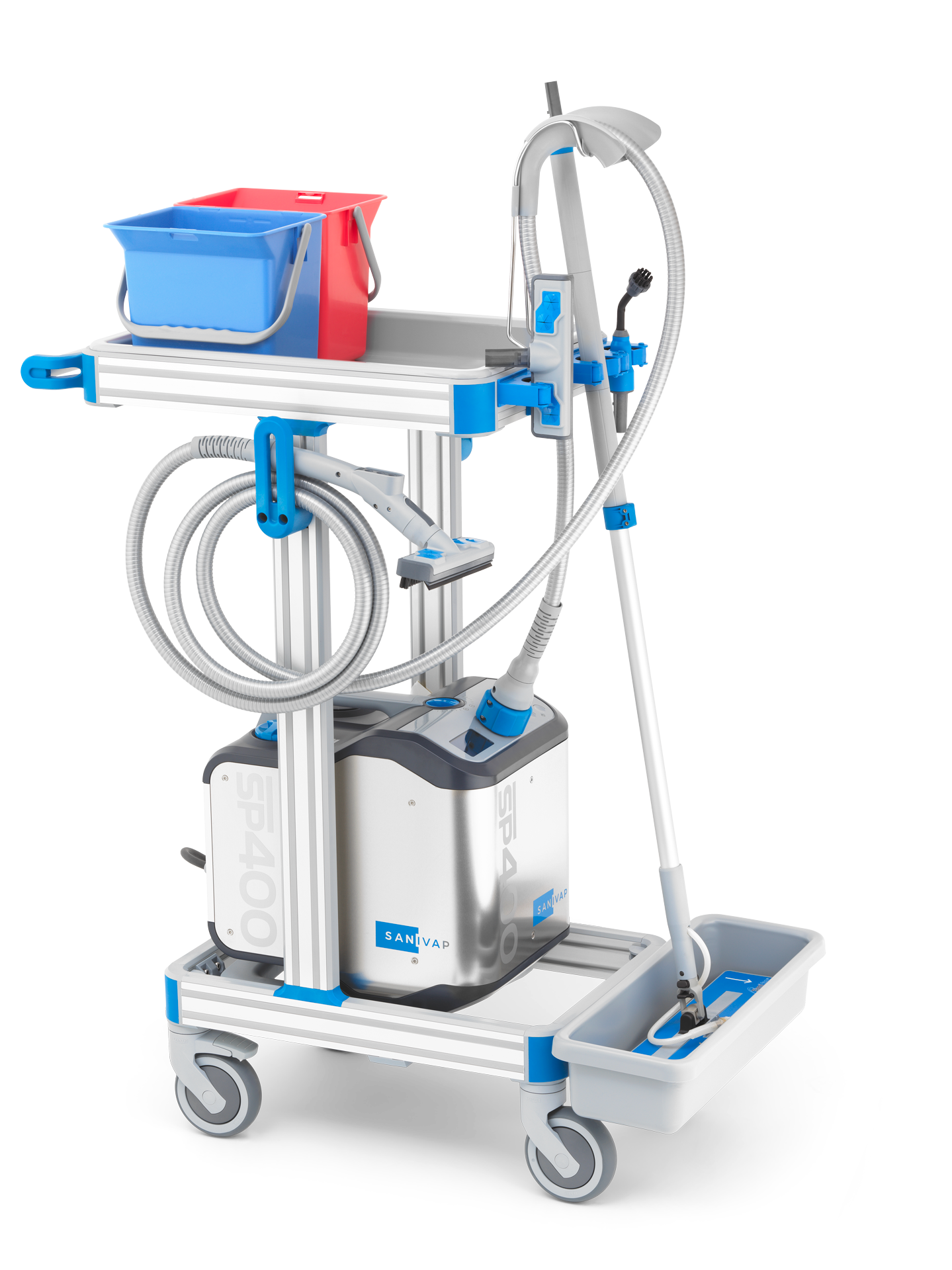
Designed for intensive professional use, Sanivap steam generators offer a high-performance, scientifically validated pest control solution, capable of eliminating bedbugs at all stages of their development, whether eggs, larvae or adults.
HIGH-TEMPERATURE STEAM AT CONSTANT PRESSURE
Thanks to steam delivered at a high temperature (constantly above 95°C at the accessory outlet) and under pressure (above 4 bar), Sanivap guarantees optimum effectiveness at the point of contact, including in hard-to-reach areas such as seams, skirting boards or cracks.
The device also offers extensive autonomy (8 to 10 hours), enabling several rooms to be treated without interruption – a major advantage in large-scale pest control operations.
EFFECTIVENESS PROVEN TO EXACTING STANDARDS
Sanivap technology has been assessed by leading laboratories, including BIOTECH GERMANDE and FONDEREPHAR (ACM Pharma).
According to the AFNOR standard NF T72-110, Sanivap technology is suitable for targeted bedbug eradication protocols. It meets the standards of effectiveness required in the most sensitive professional environments.
AN ECO-FRIENDLY, SAFE AND EASY-TO-USE SOLUTION
Sanivap’s controlled temperature prevents any damage to sensitive materials (textiles, wood, heat-sensitive surfaces). The appliance uses no chemicals, leaves no residue and does not generate excessive humidity. It can therefore be used in total safety in homes, residential establishments, schools and public areas.
Equipped with a wide range of ergonomic accessories, Sanivap makes it possible to adapt the treatment to any configuration, such as flat surfaces, furnishings, floors, and nooks and crannies.
Sanivap guarantees a lethal temperature at the point of contact, ensuring effective destruction of eggs, larvae and adult insects, without damaging the treated surfaces.
Effective bedbug eradication while protecting health and the environment
By opting for Sanivap technology, professionals have access to a proven solution for treating bedbug infestations while respecting human health and environmental constraints. As part of an overall pest control approach, it can be used on its own or in conjunction with other mechanical (vacuuming, washing) or chemical methods if required.
Safe for both users and operators, Sanivap is perfectly suited to sensitive environments such as nursing homes, schools, hotels, social housing and hospitals.
Entirely designed and manufactured in France by Oxy’Pharm, Sanivap technology embodies a high-performance, safe and sustainable solution as part of an intelligent, responsible and scientifically-backed fight against bedbugs.
Interview with Claudio Lazzari, entomologist and expert on the ANSES 2023 report on bedbugs
Claudio Lazzari, an entomologist and expert involved in the ANSES 2023 collective expertise report on bedbugs, explains that bedbugs are a serious problem throughout the world. They create a delicate problem that can affect anywhere there are gatherings of people, major events, or people moving from place to place.
He insists that bedbugs make no social distinctions. Whether you live in student accommodation or a luxury château, they settle where they find two things: dark places to hide and blood nearby. Whether mattress seams, carpet edges or electrical sockets, they find refuge in the smallest nooks and crannies, preferably near beds. What’s more, unlike lice, we don’t carry them with us. They are only active at night and move very little on their own. Instead, they travel easily with us, slipped into bags or suitcases between our clothes.
When a mosquito bites you, a raised spot appears just a few minutes later, so you can often identify the mosquito involved. What makes bedbug bites special is that the effects don’t appear for 24-48 hours, which makes it difficult to identify the location of the infestation, especially for people who are very mobile. You can carry bedbugs in your luggage if you spend the night in a five-star hotel, a youth hostel or a refuge on the El Camino hike.
To complicate matters further, these insects are tiny and can even be translucent in their early stages of development. As a result, infestations are often not spotted until they are well established.
In dealing with this situation, chemical treatments have provided limited results. The massive use of pesticides has led to the emergence of forms of resistance in bedbugs, which then makes treatments less effective. This is one of the reasons why the ANSES 2023 report focuses on alternatives to insecticides, particularly thermal ones such as steam.
Heat is a recognised mode of action. A temperature of 46 to 49°C reached by the insect’s body leads to its death. Temperatures of 42-43°C already cause a loss of coordination.
According to the expert, it is essential to understand that the temperature of the jet of air or steam does not correspond to the temperature reached by the body of the bedbug. Heat transfer depends on several parameters, such as distance, exposure time and ambient humidity. Different application conditions therefore need to be controlled to ensure that the insect’s body reaches a lethal temperature. Thermal treatments such as steam will only kill insects actually affected by the heat. If bedbugs remain sheltered under thick fabrics or in inaccessible areas, they can survive.
Claudio Lazzari states that steam has the advantage of having less impact on the environment and human health. However, ANSES has said that this solutions is moderately applicable. The entomologist stresses that to be effective, this type of heat treatment must be carried out by trained professionals who are able to identify likely hiding places, as bedbugs are only active at night and remain well hidden, away from light, the rest of the time.
For light or moderate infestations, a well-managed heat treatment may be sufficient. For more serious infestations, a combination of methods is essential. The aim is therefore not to eliminate the use of chemical products, but to limit their use as much as possible as part of an integrated pest management approach in which steam plays a major role.
Interview with Mathieu Agnet, Scientific Director of Oxy’Pharm

Mathieu Agnet, Scientific Director of Oxy’Pharm, talks about the specific technical features that make Sanivap technology stand out in the fight against bedbugs, along with the fundamental physical principles that must be understood to assess the effectiveness of a steam device.
He begins by clarifying an essential point: Performance is not determined by the temperature displayed by the unit, but rather by the temperature reached at the accessory outlet, which dictates the contact temperature with the bedbugs.
The lethal temperature for the various developmental stages of this insect is around 50°C. It is therefore necessary to guarantee at least this threshold at the point of impact, while taking care not to exceed the thermal tolerances of the materials treated.
It is also important to realise that hot air has a much lower thermal inertia level than steam and does not penetrate as well. It will therefore be less effective. This is why superheated steam at atmospheric pressure (≈100°C), thanks to its exceptional heat transfer capacity, is the best option.
Sanivap guarantees this level of performance thanks to the high standards of its technology. Sanivap machines have a boiler that rises to 155°C at a pressure of 5.5 bar, providing a particularly stable supply of superheated steam.
And Sanivap’s technical expertise doesn’t stop there: “We worked extensively on the sheathing and accessories to minimise heat loss at the boiler outlet. The result is a constant temperature of 97°C at the accessory outlet, close to the maximum permitted by the laws of physics at atmospheric pressure,” says Mathieu Agnet. This means that Sanivap technology can provide a lethal contact temperature for all stages of bedbug development.
Another crucial issue is access to the bedbugs’ typical hiding places, such as seams, skirting boards and cracks. This is where infestations persist if treatment is poorly targeted. To meet this challenge, Sanivap combines a number of advantages, including constant pressure, real-time thermal control, and ergonomic accessories designed to reach the smallest nooks and crannies. Together, they provide sufficient thermal inertia to spread the heat where it is really needed – into even the smallest cracks where bedbugs are lodged.
It is also vital not to work with too much heat. Dry, overheated air can have a “thermal stripping” effect that will damage surfaces. Steam, when produces at a speed of 10 cm/s, has been proven effective on all types of surfaces.
To prove this effectiveness, Oxy’Pharm used laboratory tests, in particular with the Centre Diagnostic Insecte in the Bouches-du-Rhône département, as well as feedback from the field in a variety of contexts (social housing, socio-medical establishments, hotels, etc.) with several years’ experience of use.
Lastly, Mathieu Agnet points out that high-temperature steam has the advantage of being active on all stages of bedbugs, from eggs to adults, and of being completely neutral in toxicological and environmental terms. It is therefore one of the most advantageous tools in an integrated pest management strategy.
“Whenever possible, steam is the eradication method that should be used as a first (and if possible last) line of defence. In certain complex cases when steam is not enough, we can combine the effect of steam with airborne insect eradication and an insecticide from the Nocotech range.”